
Services sector activities improved further and touched a five-month high in April driven by a surge in incoming new work orders that boosted business activity and supported a renewed increase in employment, according to a survey. The seasonally adjusted S&P Global India Services PMI Business Activity Index jumped to 57.9 in April, from 53.6 in March, highlighting a sharp rate of expansion that was the fastest since last November amid mounting price pressures. For the ninth straight month, the services sector witnessed an expansion in output.
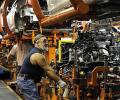
Regarding employment, the manufacturing sector hiring remained broadly unchanged.
India's services sector lost momentum in July as demand was curtailed by competitive pressures, elevated inflation and unfavourable weather, a monthly survey said on Wednesday. The seasonally adjusted S&P Global India Services PMI Business Activity Index fell from 59.2 in June to 55.5 in July, pointing to the slowest rate of growth in four months. For the 12th straight month, the services sector witnessed an expansion in output. In Purchasing Managers' Index (PMI) parlance, a print above 50 means expansion while a score below 50 denotes contraction.
.jpg)
The rupee was last at 62.05/06 after gaining to as high 61.9650 against the dollar, its highest since Nov 19. It had closed at 62.44/45 on Friday.

It will bear fruit in the next five years, which is why FDI is so strong. The foreigners clearly know what Indians don't, asserts T C A Srinivasa-Raghavan.

Stock markets crashed over 1,000 points or nearly 4 per cent on Monday, making it the biggest fall since 2008.

According to bankers and economists, there is room for further rate cut by the RBI as retail and wholesale inflation rates have remained benign.

India's manufacturing sector activity was largely flat in April, as rates of growth for new orders and output eased to eight-month lows amid the intensification of the COVID-19 crisis, a monthly survey said on Monday. The seasonally adjusted IHS Markit India Manufacturing Purchasing Managers' Index (PMI) was at 55.5 in April, little changed from March's reading of 55.4. In PMI parlance, a print above 50 means expansion while a score below 50 denotes contraction.

The HSBC/Markit Purchasing Managers Index for the services industry fell to 46.7 in December from 47.2 in November, registering the sixth consecutive monthly drop in output levels, the longest period of continuous reduction since the 2008/2009 global financial crisis.

Manufacturers indicated that the ongoing relaxation of COVID-19 restrictions, better market conditions and improved demand helped them to secure new work in October.

Experts said the slowdown could be attributed to adjustments leading to destocking and the offering of discounts by companies as the government ushered in the new indirect taxation system on July 1.

India's private sector activity contracted further in August, reflecting faster contractions of both manufacturing and services output, amid decline in new orders and tough economic conditions.

India's services sector activities touched the highest mark since April 2011 amid ongoing improvements in demand conditions, even as cost pressures in the service economy remained stubbornly high, a monthly survey said on Tuesday. The seasonally adjusted S&P Global India Services PMI Business Activity Index rose from 58.9 in May to 59.2 in June -- its highest mark since April 2011. For the eleventh straight month, the services sector witnessed an expansion in output. In Purchasing Managers' Index (PMI) parlance, a print above 50 means expansion while a score below 50 denotes contraction.

The HSBC/Markit purchasing managers index for the services industry inched up to 47.1 in October from 44.6 in September, the fourth successive monthly contraction of service sector output across India.

India's manufacturing sector activity witnessed a significant loss of growth momentum in May due to the intensification of the COVID-19 crisis and its detrimental impact on demand, a monthly survey said on Tuesday. The seasonally adjusted IHS Markit India Manufacturing Purchasing Managers' Index (PMI), fell to 50.8 in May, down from 55.5 in April, as companies observed the slowest rises in new work and output in ten months amid intensification of the COVID-19 crisis. In PMI parlance, a print above 50 means expansion while a score below 50 denotes contraction.
India's services sector activities improved further and expanded at strongest rate in over 11 years in May, supported by a substantial pick-up in new business growth, even as input cost inflation climbed to a record high, a monthly survey said on Friday. The seasonally adjusted S&P Global India Services PMI Business Activity Index jumped to 58.9 in May, up from 57.9 in April, amid better underlying demand and strong inflows of new work. For the tenth straight month, the services sector witnessed an expansion in output.
India's services sector activity expanded at the second-fastest pace in more than a decade during November, driven by sustained rise in new work and improvement in market conditions, a monthly survey said on Friday. The seasonally adjusted India Services Business Activity Index was at 58.1 in November, fractionally down from 58.4 in October. The November figure points to the second-fastest rise in output since July 2011. For the fourth straight month, the services sector witnessed an expansion in output.

Investors turned defensive and lapped up information technology and healthcare stocks.

The official survey focuses more on larger firms.
India's services sector activity moderated further in January as new business rose at a noticeably slower rate amid the escalation of the pandemic, reintroduction of restrictions and inflationary pressures, a monthly survey said on Thursday. The seasonally adjusted India Services Business Activity Index fell to 51.5 in January, down from 55.5 in December, pointing to the slowest rate of expansion in the current six-month sequence of growth. For the sixth straight month, the services sector witnessed an expansion in output.

tailwinds of a remarkable year and handsome investor returns, Indian equities are set for an eventful journey in 2024, with a slew of local and global cues -- varying from interest rates to Lok Sabha polls to geopolitical happenings. Analysts are of the view that the bull run in the domestic equity market will continue, and over the next 3-6 months, the benchmark indices -- Sensex and Nifty -- could climb up to 7 per cent. In 2023, the 30-share BSE Sensex jumped 11,399.52 points or 18.73 per cent, and the NSE Nifty climbed 3,626.1 points or 20 per cent.

Macroeconomic data announcements, the Covid situation in China and global market cues would guide Dalal Street in the first week of trading in the New Year, analysts said. Markets would also keep a track on rupee movement, Brent crude oil prices and foreign fund investment trends. "As market players attempt to understand the Fed's stance, Indian markets may respond in lockstep with their international counterparts when the Federal Open Market Committee (FOMC) minutes are made public later this week.

n the broader market, both the BSE Midcap and Smallcap indices, were up 1.2% and 0.7% each.

Other major laggards were IndusInd Bank, SBI, Bharti Airtel, ONGC, Tata Steel and Reliance Industries -- falling as much as 6.30 per cent.
The seasonally adjusted India Services Business Activity Index rose from 45.4 in July to 56.7 in August, as the reopening of several establishments and increased consumer footfall boosted sales. The services sector witnessed the first expansion in output in four months and a rebound in business confidence.

India appears poised to sustain its growth in a more durable way than before with the economy carrying the momentum from FY23 into the current fiscal year, the Annual Economic Review for 2022-23 released by the finance ministry on Thursday said. However, the report cautioned that escalation of geopolitical stress, enhanced volatility in global financial systems, sharp price correction in global stock markets, a high magnitude of El-Nino impact, and modest trade activity and FDI inflows, are factors that could constrain the pace of growth. "Should these developments deepen and dampen growth in the subsequent quarters, the external sector may challenge India's growth outlook for FY24," the finance ministry said.

The HSBC/Markit Purchasing Managers Index for the services industry inched up to 47.2 in November from 47.1 in October, the fifth sub-50.0 reading and indicated an output contraction across the Indian service economy.
India's services activity expanded at the fastest rate in a year during February, while employment fell further and companies noted the sharpest rise in overall expenses, a monthly survey said on Wednesday. The seasonally adjusted India Services Business Activity Index rose from 52.8 in January to 55.3 in February, pointing to the sharpest rate of expansion in output in a year amid improved demand and more favourable market conditions. The index was above the critical 50 mark that separates growth from contraction for the fifth month in a row during February as the roll-out of COVID-19 vaccines led to an improvement in business confidence towards growth prospects.

The seasonally adjusted IHS Markit India Manufacturing Purchasing Managers' Index (PMI) fell from 58.9 in October to a three-month low of 56.3 in November, indicating that the manufacturing sector growth remained strong, despite losing traction.

India's services industry expanded at its fastest pace in eight months in October as new business rose with discounting probably stoking demand, a survey showed on Wednesday.

Services companies reported an increase in new work intakes, which they attributed to successful marketing efforts and strengthening demand.

India's services sector activity expanded at the strongest pace in ten-and-a-half years in October, driven by a substantial upturn in business activity amid favourable demand conditions, a monthly survey said on Wednesday. Companies indicated that a notable pick-up in new business led to the fastest expansion in output in over a decade and as a result more jobs were created, even though business confidence remained subdued due to growing inflationary concerns. The seasonally adjusted India Services Business Activity Index rose from 55.2 in September to 58.4 in October, signalling the strongest rate of growth in ten-and-a-half years.

Heavy dollar selling by banks and exporters alongside debt-related inflows largely supported the rupee
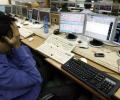
Top losers are Sun Pharma, Bajaj Auto, L&T, ITC, Hero Moto.

Wall Street brokerage Goldman Sachs has lowered its estimate for India's economic growth to 11.1 per cent in fiscal year to March 31, 2022, as a number of cities and states announced lockdowns of varying intensities to check spread of coronavirus infections. India is suffering the world's worst outbreak of COVID-19 cases, with deaths crossing 2.22 lakh and new cases above 3.5 lakh daily. This has led to demand for imposition of nationwide strict lockdowns to stem the spread of the virus - a move that the Modi government has so far avoided after the economic devastation last year from a similar strategy.

IndusInd Bank was the top gainer in the Sensex pack, zooming over 12 per cent, followed by Bajaj Finance, Axis Bank, ICICI Bank, Tech Mahindra, Bajaj Finserv and Kotak Bank. On the other hand, ITC, NTPC, Titan, Reliance Industries and ONGC were the laggards.
India's services sector activity moderated in December as business activity and sales rose at a softer pace, while price pressures and the possibility of new waves of Covid-19 affected business sentiment, a monthly survey said on Wednesday. The seasonally adjusted India Services Business Activity Index fell from 58.1 in November to a three-month low of 55.5 in December. The rates of expansion moderated but were nevertheless "marked" by historical standards, the survey said.
Macro-economic data from China and minutes of the US Federal Reserve's last meeting caused the turmoil as stocks tumbled around the globe.

IndusInd Bank was the top gainer in the Sensex pack, rising nearly 6 per cent, followed by Axis Bank, SBI, Maruti, Tech Mahindra and Reliance Industries. NSE Nifty surged 183.70 points to close at 17,166.90.
India's services sector activity continued to expand in September, supported by favourable underlying demand amid the easing of COVID-19 restrictions, but lost some momentum from August's 18-month high level, a monthly survey said on Tuesday. The seasonally adjusted India Services Business Activity Index fell from 56.7 in August to 55.2 in September, but remained well above its long-run average. "Despite easing from August, the rate of expansion was marked and the second-fastest since February 2020," the survey said.
 © 2026 Rediff.com - Advertise with us - Disclaimer - Privacy Policy - Sitemap - Feedback - About us - Terms of use - Grievances